Path of a Pre-Service Teacher

Thursday, June 30, 2016

WOW Factor: Close Reading with Text Dependent Questions

Close reading is a critical analysis of a text that focuses on significant details in order to develop a deep, precise understanding of the text's structure, craft, meanings, etc. It directs the reader's attention to the text itself. Students can close read a text over a period of days to fully understand and grasp its content.

The three tiers of close reading are:
  1. Author's point of view, vocabulary, text structure - How does the text work?
  2. Main idea, details - What does the text say?
  3. Inferences, synthesis, critiques- What does the text mean?
The purpose of close reading is for students to interact with the text. By asking thoughtful and purposeful questions, like the ones highlighted above, students are better able to identify the author's craft and main idea and look for evidence to support their inferences. These questions are called text-dependent questions.

Text-dependent questions are ones that can only be answered by referring back to the text. The image below represents the steps from part to whole. Students would begin at "general understandings."
The steps for creating text-dependent questions are:
  1. Identifying the core understandings and key ideas of the text - start by identifying the key insights that you want the students to understand from the text, keeping an eye on the major points in order to construct successful questions.
  2. Start small to build confidence - the opening questions should be ones that help orientate the students to the text and be sufficiently specific enough for them to answer so that they can gain confidence to tackle more difficult questions later on.
  3. Target vocabulary and text structure - locate key text structures and the most powerful academic words in the text that are connected to the key ideas and understandings, and craft questions that make these connections.
  4. Tackle through sections head-on - find sections of the text that will present the greatest difficulty and craft questions that support students in mastering these sections (these could be sections with difficulty syntax, particularly dense information, tricky transitions or places that offer a variety of possible inferences).
  5. Create coherent sequences of text-dependent questions - the sequence of questions should not be random, but should build toward more coherent understanding and analysis to ensure that students learn how to stay focused on the text to bring them to a gradual understanding of its meaning.
  6. Identify the standards that are being addressed - take notice of what standards are being addressed in the series of questions and decide if any other standards are suited to being a focus for this text (forming additional questions that exercise those standards).
  7. Create the culminating assessment - develop a culminating activity around the key idea or understandings identified earlier that reflects (a) mastery of one or more of the standards, (b) involves writing, (c) is structured to be completed by students independently.
Examples of text-dependent questions for the three tiers could include:
  • Author's craft
    • The author chose to use lists or other features. Does this make the text easier to read or more complex?
    • Using the illustration and text on page ____, describe _________.
  • Main idea/details
    • What words or phrases does the author use to help you locate the main idea?
    • How does the word(s) _________ tell you more about _______? Explain your answer.
  • Inferences/critiques
    • After reading this section, what stood out to you?
    • This reminds me of ___________ within the text or beyond the text.
    • How do the illustrations, captions, etc. help you infer _________about the plot? Why might the author have done this?
 

The following video explains using stems to create text-dependent questions

This video displays the process and steps of creating questions for your students
(both videos were retrieved from YouTube)

For more information and useful tips, visit:


Friday, June 24, 2016

Effective Comprehension Instruction: what is it and how is it part of the gradual release?

According to the Texas Education Agency, effective comprehension instruction is instruction that helps students become independent, strategic, and metacognitive readers who are able to develop, control, and use a wide variety of comprehension strategies to ensure that they understand what they read. Comprehension instruction must begin as soon as students begin to read in order to achieve this goal. This instruction should not only motivate students to read widely, but should also be explicit, intensive, and persistent.

Explicit, Intensive, and Persistent Instruction

In comprehension strategy instruction the teacher chooses strategies that are closely aligned with the text students are reading. The teacher:
  • models the given strategy and why it is important
  • helps students learn how, when, and where to use the strategy
  • gives students the opportunity to apply the strategy on their own
The teacher must model, followed by practice and guided reading to help students understand the strategy completely and when to use it independently. Discussion and feedback are also important when introducing a new strategy.

The gradual release of responsibility plays a key role in explicit instruction. The goal is for students to apply what they have learned. However, teachers do not ask students to work on their own until they have demonstrated that they understand the strategy, and how and when to use it.

Key Comprehension Strategies 

These strategies range from simple to complex and can be highly useful.
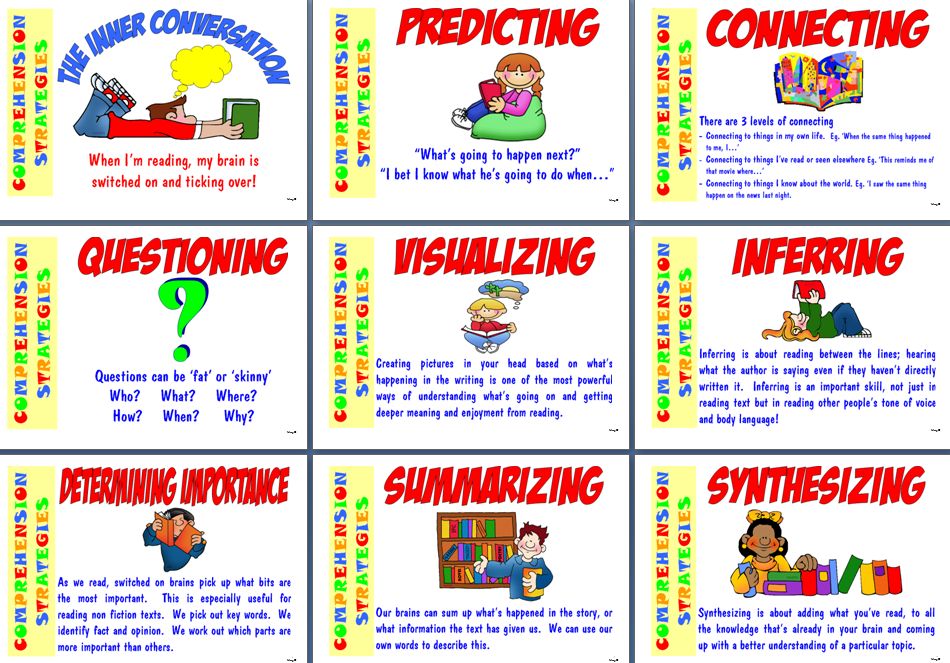
  1. Activating and using background knowledge - requires readers to activate their background knowledge and use that to help them understand what they are reading. In other words, how can the student make connections to the text.
  2. Generating and asking questions - readers ask themselves questions throughout the reading of the text. This is valuable in helping them integrate information, identify main ideas, and summarize information. Key questions to ask include: who, what, where, when, why, and how.
  3. Making inferences - requires readers to evaluate or draw conclusions from information in a text or "read between the lines." This strategy improves students' ability to construct meaning.
  4. Predicting - involves the ability of readers to get meaning from a text by making informed predictions. During reading, students make predictions about what is going to happen next.
  5. Summarizing - involves the ability of readers to pull together or synthesize information in a text to explain in their own words what the text is about. This can include such things as connecting or synthesizing events in a story or identifying a character's motives.
  6. Visualizing - involves the ability of readers to make mental images or pictures of a text as a way to understand processes or events they encounter during reading.
  7. Monitoring - the ability of readers to know when or when not they understand what they read, and to use appropriate strategies to improve their understanding. It is a form of the child's metacognition.
The image below represents each comprehension strategy and important questions to ask.

                                                                (retrieved from google images)

Activities that Promote Comprehension
  • retelling of a story
  • story maps
  • story frames
  • directed reading and thinking activity
  • KWL chart
  • I-chart procedure
For more information about these activities, visit http://www.readingrockets.org/article/strategies-promote-comprehension.


The video below, shared from Reading Rockets, includes a panel of reading experts discussing the building blocks of comprehension, what good instruction looks like, assessing comprehension in children with dyslexia and more.

(retrieved from YouTube)

Reading Rockets is a great tool to use for parents and teachers on comprehension instruction and many other content areas.

Share your thoughts:  Why is effective comprehension instruction important to use in the classroom? What makes the difference between a poor reader and a good reader?


References:
Comprehension Instruction, 12-15. Retrieved from http://www.netxv.net/pm_attach/67/TRI-Comprehension_Instr.pdf.
Texas Educational Agency. (2002). Comprehension Instruction, 9-12. Retrieved from http://www.netxv.net/pm_attach/67/TRI-Comprehension_Instr.pdf.

Friday, June 17, 2016

Wide Reading in the Classroom

What is supported wide reading?


Supported wide reading is:

  • personal reading in a social context
  • an individualized program which matches students’ interests and abilities
  • a regular opportunity for students to individually read texts of their own choice within the classroom
  • an extension of students' reading to include a wide range of texts and genres
Examples of genres to provide for children include:
  • fantasy/science fiction
  • historical fiction
  • biography
  •   informational books
  • poetry
The important features are:
  • a broad definition of texts which includes a variety of fiction/non-fiction
  • ease of accessibility for individuals to select texts
  • self-monitoring and teacher monitoring of the process
  • setting of personal goals for reading
  • regular opportunities for students to talk about the texts they are reading
  • teacher modelling of and enthusiasm for reading
  • enjoyment and celebration of reading by students and their peers
  • exciting reading corner in the classroom which includes information about texts and authors and displays of student and teacher recommendations for reading
How does wide reading support vocabulary development and word knowledge?
Sharing lots of different kinds, or genres, of books with young readers exposes them to different words, different pictures, and whole new worlds.


Selecting words to teach:
When selecting vocabulary to teach to students, teachers should carefully choose tier 2 and tier 3 words. Tier 2 words are words that mean different things in different content areas or contexts and tier 3 words are words that are content specific words. When selecting vocabulary, it is also important to consider a few important questions, such as:
  • Will the word be used again during the school year?
  • Will the word be used in group discussions?
  • Will the word be used in other content or subject areas?
  • Can students use context clues to determine the correct or intended meaning of the word without instruction?

Share your thoughts:
What steps do you take in building your students vocabulary? How many words do you believe should be taught at a time? 

References:
Douglas Fisher & Nancy Frey (2014). Content Area Vocabulary Learning. Content Area Literacy. pp.594-pp.598
http://www.readingrockets.org/article/importance-reading-widely
goldfieldsliteracy.wikispaces.com/file/view/What+is+Supported+Wide+Reading.doc


Friday, June 10, 2016

How are texts leveled and what should students know about their reading level?


One way in which texts are leveled is through the Learning A-Z text leveling system. With the help of teachers and instructional experts, a variety of books ranging in difficulty were analyzed to create developmentally appropriate levels for students. This system follows the Common Core State Standards guidelines. The Standards evaluate reading in three levels of text complexity: qualitative measures, quantitative measures, and reader and task considerations. The Learning A-Z text leveling system looks at both quantitative and qualitative measures to accurately determine the level of a text.

Qualitative measures are text attributes that can only be evaluated by the reader.  The Learning A-Z text leveling system looks at factors such as:

·         Predictability of a text

·         Text structure and organization

·         Illustration support

·         Knowledge demands

Ø  Concept load

Ø  Familiarity of a topic

Quantitative measures are statistical measurements of text. These include factors such as:

·         Total word count

·         Number of different words

·         Number of high frequency words

·         Sentence length

·         Sentence complexity

Considerations of the reader and the reading task is a component teachers must evaluate. No leveling system can include these considerations because they depend on each individual student. Each reader brings different skills, background, and motivation to the act of reading.

The Learning A-Z text leveling system allows teachers to focus more on reader and task considerations after qualitative and quantitative measures of a text have been assessed.

Students should know that their reading level does not define them as a learner. Students’ progress through “just right leveled texts” in the elementary years. We, as educators, must help children understand that their ‘level’ is a low indicator of their abilities and strengths. Levels become a concern when students confuse the level of text they are reading with the kind of reader they have the potential to be. We have to remind children that we can’t judge a book by its cover just like we can’t judge a reader by their level!

References:
https://www.readinga-z.com/learninga-z-levels/text-leveling-system/
http://www.angelamaiers.com/2009/09/minilesson-a-different-look-at-reading-levels/