Explicit, Intensive, and Persistent Instruction
In comprehension strategy instruction the teacher chooses strategies that are closely aligned with the text students are reading. The teacher:
- models the given strategy and why it is important
- helps students learn how, when, and where to use the strategy
- gives students the opportunity to apply the strategy on their own
The teacher must model, followed by practice and guided reading to help students understand the strategy completely and when to use it independently. Discussion and feedback are also important when introducing a new strategy.
The gradual release of responsibility plays a key role in explicit instruction. The goal is for students to apply what they have learned. However, teachers do not ask students to work on their own until they have demonstrated that they understand the strategy, and how and when to use it.
Key Comprehension Strategies
These strategies range from simple to complex and can be highly useful.
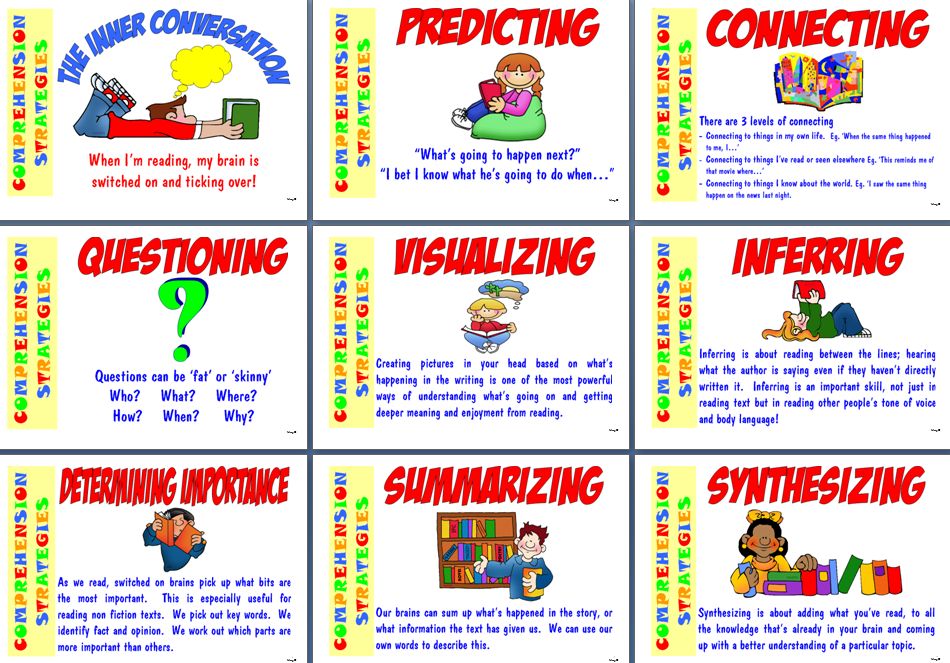
- Activating and using background knowledge - requires readers to activate their background knowledge and use that to help them understand what they are reading. In other words, how can the student make connections to the text.
- Generating and asking questions - readers ask themselves questions throughout the reading of the text. This is valuable in helping them integrate information, identify main ideas, and summarize information. Key questions to ask include: who, what, where, when, why, and how.
- Making inferences - requires readers to evaluate or draw conclusions from information in a text or "read between the lines." This strategy improves students' ability to construct meaning.
- Predicting - involves the ability of readers to get meaning from a text by making informed predictions. During reading, students make predictions about what is going to happen next.
- Summarizing - involves the ability of readers to pull together or synthesize information in a text to explain in their own words what the text is about. This can include such things as connecting or synthesizing events in a story or identifying a character's motives.
- Visualizing - involves the ability of readers to make mental images or pictures of a text as a way to understand processes or events they encounter during reading.
- Monitoring - the ability of readers to know when or when not they understand what they read, and to use appropriate strategies to improve their understanding. It is a form of the child's metacognition.
The image below represents each comprehension strategy and important questions to ask.
(retrieved from google images)
Activities that Promote Comprehension
- retelling of a story
- story maps
- story frames
- directed reading and thinking activity
- KWL chart
- I-chart procedure
For more information about these activities, visit http://www.readingrockets.org/article/strategies-promote-comprehension.
The video below, shared from Reading Rockets, includes a panel of reading experts discussing the building blocks of comprehension, what good instruction looks like, assessing comprehension in children with dyslexia and more.
(retrieved from YouTube)
Reading Rockets is a great tool to use for parents and teachers on comprehension instruction and many other content areas.
Share your thoughts: Why is effective comprehension instruction important to use in the classroom? What makes the difference between a poor reader and a good reader?
References:
Comprehension Instruction, 12-15. Retrieved from http://www.netxv.net/pm_attach/67/TRI-Comprehension_Instr.pdf.
Texas Educational Agency. (2002). Comprehension Instruction, 9-12. Retrieved from http://www.netxv.net/pm_attach/67/TRI-Comprehension_Instr.pdf.

No comments:
Post a Comment